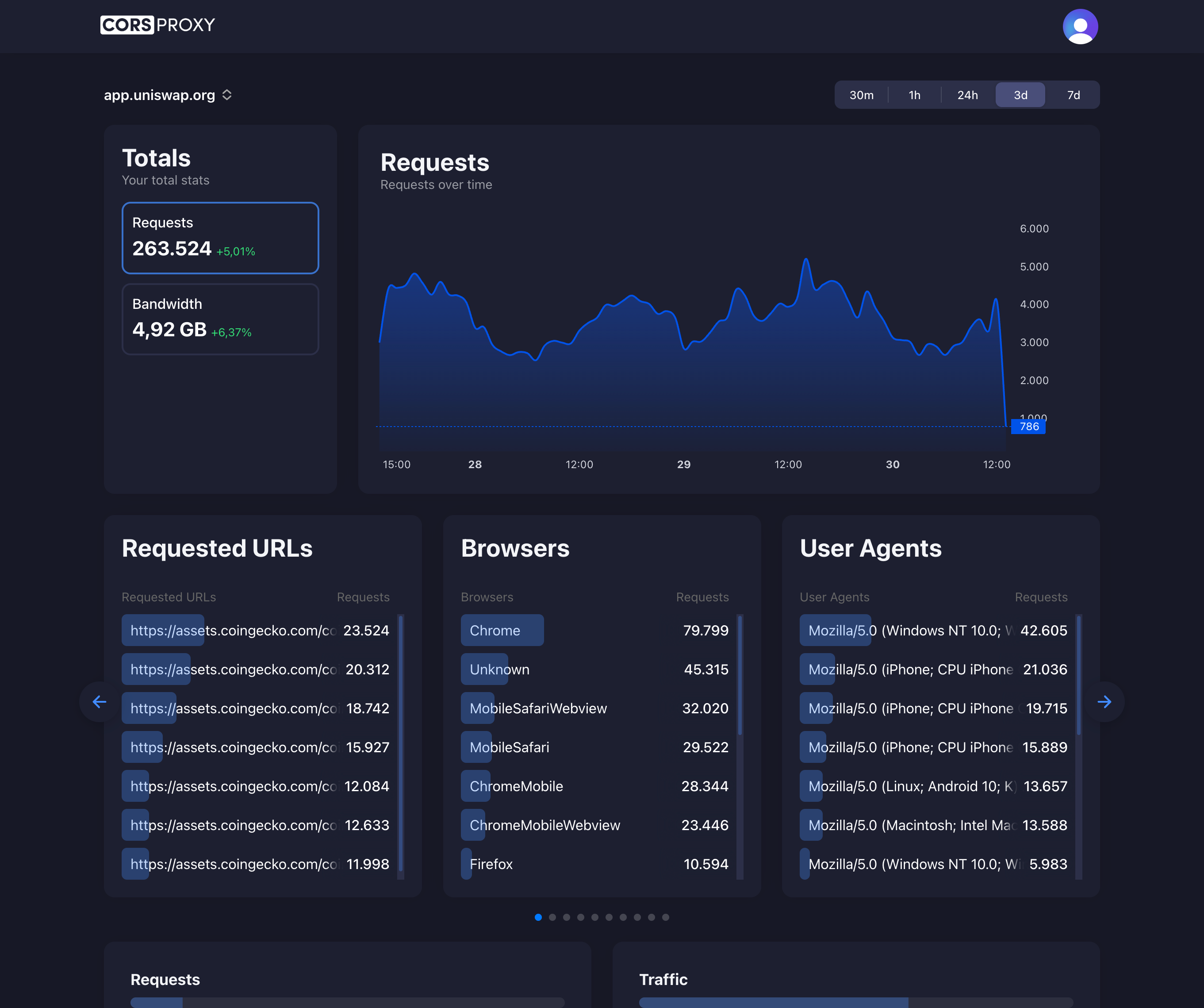
Before copying a CORSPROXY request, replace the API-key placeholder with your account key and register the browser app’s domain. Free is for browser requests; server-side use needs a paid plan, and conversion, extraction, or custom caching needs Production. Follow the first-request guide for setup and error diagnosis.
What is a Caching Proxy?
A caching proxy temporarily stores copies of web resources like HTML pages, images, videos, and API responses. When users request cached content, the proxy serves it directly from local storage rather than fetching from origin servers. This dramatically improves load times, reduces bandwidth costs, and decreases origin server load—making caching proxies essential infrastructure for high-traffic websites, corporate networks, ISPs, and content delivery networks.
Caching proxies operate transparently implementing HTTP caching standards defined by Cache-Control headers, ETags, and expiration directives. The proxy examines response headers determining cache eligibility and lifetime, stores cacheable content, validates cached content freshness, and serves cached responses satisfying subsequent requests without origin server involvement.
How Caching Proxies Work
Client requests reach the caching proxy before proceeding to origin servers. The proxy checks its cache for matching content using request URLs and cache keys. Cache hits—where fresh, valid cached content exists—return immediately without origin contact. Response times drop from hundreds of milliseconds to single-digit milliseconds for cached content.
Cache misses—where no cached content exists or cached content expired—forward requests to origin servers. The proxy receives origin responses, examines cache headers determining storage eligibility, stores cacheable responses according to TTL (time-to-live) directives, and forwards responses to clients. Subsequent requests for identical content become cache hits.
Cache validation for expired content uses conditional requests (If-Modified-Since, If-None-Match headers) checking whether cached content remains current. Origin servers return “304 Not Modified” responses when cached content stays valid, avoiding full content retransfer while ensuring freshness. New content receives “200 OK” responses with updated resources replacing stale cache entries.
Types of Caching Proxies
Forward Caching Proxy
Forward caching proxies sit between clients and the internet, caching outbound requests from internal users. Corporate networks and ISPs deploy forward caching proxies reducing external bandwidth costs as employees repeatedly access popular websites. Internal cache hits consume no external bandwidth improving response times while reducing transit costs.
Reverse Caching Proxy
Reverse caching proxies sit in front of origin servers caching responses before reaching users. This server-side caching protects backend infrastructure from excessive load enabling horizontal scaling through cache hits rather than additional application servers. Cloudflare, Fastly, and Varnish represent popular reverse caching proxy solutions.
Hierarchical Caching
Large organizations deploy multiple caching tiers creating cache hierarchies. Client requests check local caches, escalate to regional caches, check national caches, and finally reach origin servers if no tier contains cached content. This multi-level caching distributes storage across network layers optimizing cache hit rates and bandwidth utilization.
Caching Proxy Use Cases
Corporate Bandwidth Optimization
Organizations with hundreds or thousands of employees accessing identical websites benefit significantly from forward caching proxies. Popular sites like news portals, cloud services, and software downloads cache locally preventing repeated external fetches. Bandwidth savings reach 30-60% for typical office environments.
Internal cache hits deliver content at LAN speeds (gigabit) versus WAN speeds (hundreds of megabits or less). User experience improvements extend beyond bandwidth savings—latency drops from internet round-trips measured in tens or hundreds of milliseconds to LAN round-trips under milliseconds.
ISP Traffic Management
Internet Service Providers deploy caching proxies reducing transit costs and improving customer experience. Popular content—YouTube videos, Netflix streams, software updates—caches locally enabling ISPs to serve repeated requests without expensive transit bandwidth. Customers experience faster content delivery from local caches versus distant origin servers.
Transparent caching intercepts HTTP traffic automatically without customer configuration. Subscribers benefit from caching without awareness as requests automatically route through ISP cache infrastructure. This deployment model maximizes cache utilization across the subscriber base.
Web Application Acceleration
Reverse caching proxies accelerate web applications by serving cached responses for computationally expensive operations. Database queries, API calls, rendered templates all cache when appropriate reducing backend load and improving response times. Applications handle 10-100x more traffic through effective caching versus serving every request from application servers.
Cache invalidation strategies ensure users receive fresh content despite caching. Time-based expiration, conditional validation, and manual purging balance freshness requirements against performance benefits. Applications explicitly control caching through response headers defining what caches, for how long, and under what conditions.
API Response Caching
REST APIs benefit from response caching reducing database load and improving latency. Read-heavy endpoints serving relatively static data—user profiles, product catalogs, configuration data—cache aggressively. Subsequent API calls serve from cache rather than executing database queries and application logic repeatedly.
Rate limiting at caching layers prevents abuse protecting backend infrastructure. Cached responses consume minimal resources satisfying rate-limited requests from cache rather than overwhelming origin servers. This protection maintains service availability despite traffic spikes or malicious request patterns.
Static Asset Delivery
Images, CSS, JavaScript, fonts, and other static assets benefit maximally from caching as they rarely change. Caching proxies store static assets with long TTLs (hours to days) serving repeated requests without origin involvement. This usage pattern achieves the highest cache hit rates—often exceeding 90%—for static content.
Using Caching with CorsProxy
CorsProxy provides automatic caching for API responses and content without infrastructure management:
// Automatic caching for API responses
const response = await fetch(
  `https://corsproxy.io/?url=${encodeURIComponent('https://api.example.com/data')}&key=your-api-key`
);

const data = await response.json();
// Automatic edge caching reduces latency and costs
This approach provides caching benefits—reduced latency, lower bandwidth costs, decreased origin load—without deploying cache infrastructure, configuring cache policies, or managing cache invalidation.
Caching Proxy Software
Squid
Squid represents the most widely deployed open-source caching proxy supporting HTTP, HTTPS, FTP, and custom protocols. Configuration flexibility enables complex caching rules, access controls, and authentication schemes. Organizations from small businesses to ISPs serving millions deploy Squid for forward and reverse caching scenarios.
Varnish Cache
Varnish specializes in high-performance HTTP reverse caching handling tens of thousands of requests per second. Memory-based caching and efficient architecture enable Wikipedia, The New York Times, and Tumblr to handle massive traffic loads. VCL (Varnish Configuration Language) provides sophisticated cache policy customization.
Nginx Proxy Cache
Nginx’s reverse proxy caching capabilities combine web serving and caching in unified infrastructure. The proxy_cache module implements efficient disk-based caching with flexible policies. Nginx’s performance and resource efficiency make it popular for both forward and reverse caching deployments.
Caching Proxy Pricing
Open-source caching proxy software (Squid, Nginx, Varnish) remains free without licensing costs. Infrastructure expenses—servers, storage, bandwidth—represent the only costs for self-hosted deployments. Organizations deploy caching proxies handling petabytes of traffic without software licensing fees.
Commercial caching services and CDNs charge based on bandwidth and requests. Cloudflare, Fastly, and Akamai pricing ranges from hundreds to thousands of dollars monthly depending on traffic volumes. Managed caching services eliminate infrastructure management while adding service fees to total costs.
Cloud-based caching (AWS CloudFront, Google Cloud CDN, Azure CDN) charges per GB of data transfer ($0.08-$0.20 per GB) and per 10,000 requests ($0.01-$0.02). Pay-as-you-go models suit variable traffic patterns while committed use discounts reduce costs for predictable workloads.
Best Practices for Caching Proxies
Configure appropriate TTLs balancing freshness and cache efficiency. Static assets cache for hours or days with long TTLs maximizing hit rates. Dynamic content caches for seconds or minutes ensuring reasonable freshness while still reducing origin load. Overly short TTLs waste caching infrastructure while overly long TTLs serve stale content.
Implement cache key strategies considering URL parameters and headers affecting responses. Different cache entries for mobile versus desktop, authenticated versus anonymous, or region-specific content prevent serving inappropriate cached responses. Proper cache key design ensures cache correctness while maximizing hit rates.
Monitor cache hit rates identifying optimization opportunities. Hit rates below 50% suggest caching configuration problems or inappropriate content caching. Hit rates above 80% indicate effective caching providing substantial bandwidth and latency benefits. Rate tracking by content type reveals which resources benefit most from caching.
Size cache storage appropriately balancing hit rates against infrastructure costs. Undersized caches evict frequently accessed content before TTL expiration reducing effectiveness. Oversized caches waste storage and memory without proportional hit rate improvements. Optimal sizing depends on content patterns and access frequency distribution.
Advantages of Caching Proxies
Dramatic performance improvements as cached content serves in milliseconds versus hundreds of milliseconds for origin fetches. Users experience faster page loads, improved application responsiveness, and better overall experience. Latency reduction matters especially for geographically distributed users distant from origin servers.
Significant bandwidth cost reduction as cache hits consume no external bandwidth. Organizations paying per-GB for internet transit achieve 30-60% cost savings through effective caching. ISPs reduce expensive peering and transit costs serving popular content from local caches.
Origin server load reduction enables handling more traffic with existing infrastructure. Database queries, application processing, and computational overhead decrease proportionally to cache hit rates. This scaling through caching often proves more cost-effective than adding application servers.
Improved reliability as caching proxies continue serving cached content despite origin failures. Degraded service beats complete outages—users access cached content maintaining partial functionality until origin restoration. This resilience improves perceived uptime and user satisfaction.
Limitations of Caching Proxies
Stale content risk when cached responses become outdated before TTL expiration. Breaking news, price changes, inventory updates all require careful TTL selection balancing freshness and cache efficiency. Manual purging or short TTLs mitigate staleness at the cost of reduced caching benefits.
Cache invalidation complexity for dynamic content with complex dependencies. Updating one database record may invalidate dozens of cached responses with interdependencies. Sophisticated purging strategies or tag-based invalidation help but add complexity to caching infrastructure.
Storage requirements for high-traffic sites with diverse content. Effective caching requires storing substantial portions of frequently accessed content. Storage costs and management overhead offset some caching benefits especially for sites with extensive unique content.
Limited effectiveness for highly personalized content where every user receives unique responses. User-specific recommendations, dashboards, and dynamic pages cache poorly as each request returns different content. Caching provides minimal benefit for one-user-one-cache-entry scenarios.
When to Choose Caching Proxies
Choose caching proxies for high-traffic websites and applications where repeated content access justifies caching infrastructure. Sites with substantial static assets, relatively stable dynamic content, or expensive computational operations benefit most from caching. Cache hit rates exceeding 50% typically justify deployment costs.
Use caching proxies for organizations with many users accessing identical external resources. Corporate networks, schools, and libraries achieve significant bandwidth savings through forward caching as users repeatedly access popular sites. Cost savings and performance improvements quickly justify implementation effort.
Skip caching proxies for highly dynamic, user-specific applications where content rarely repeats across users. Unique dashboard data, personalized feeds, and custom computations cache poorly providing minimal benefit. Simple applications with low traffic don’t justify caching complexity and management overhead.