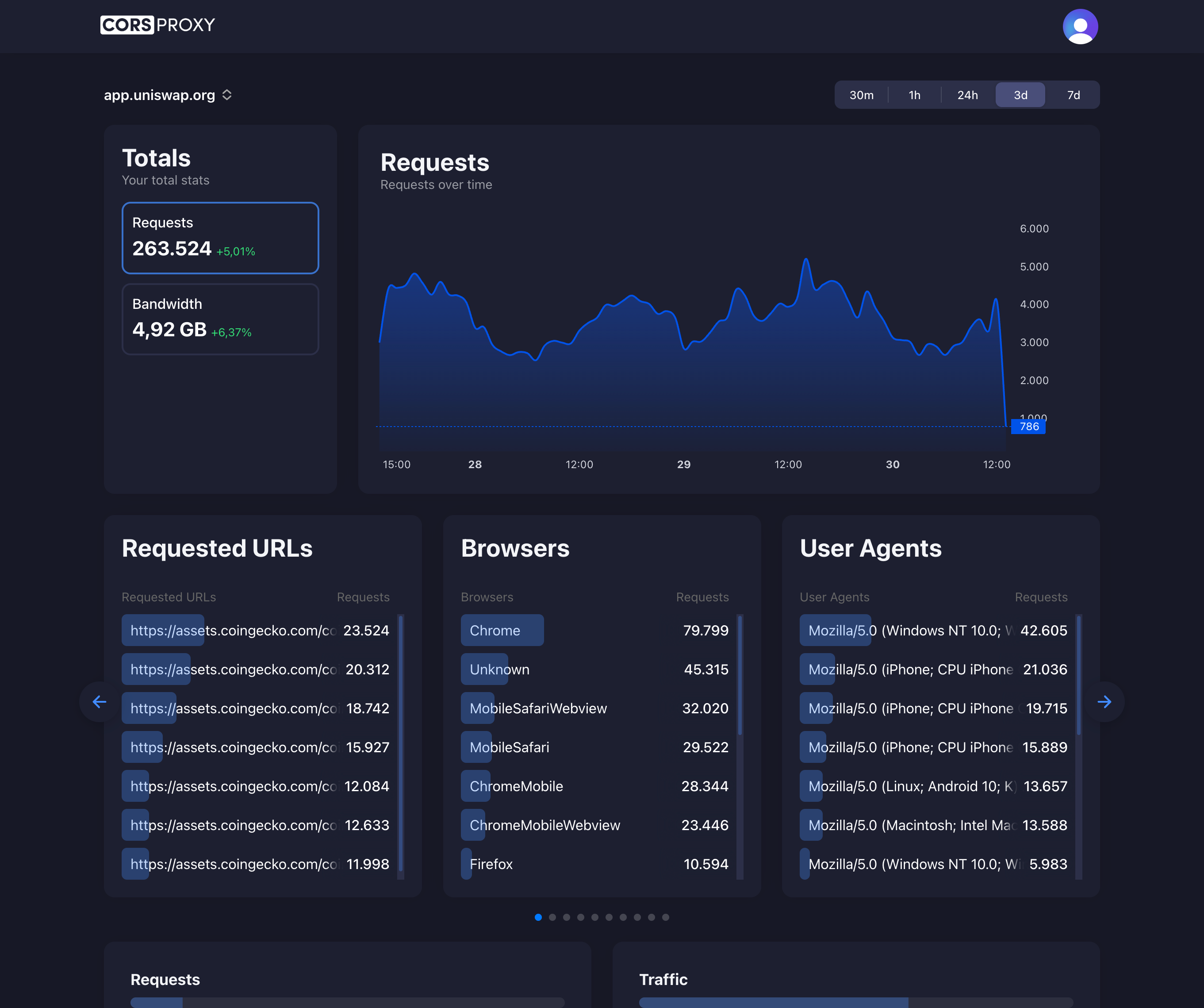
Before copying a CORSPROXY request, replace the API-key placeholder with your account key and register the browser app’s domain. Free is for browser requests; server-side use needs a paid plan, and conversion, extraction, or custom caching needs Production. Follow the first-request guide for setup and error diagnosis.
If you’ve encountered cryptic browser console warnings like “Cross-Origin Read Blocking (CORB) blocked cross-origin response” or “ERR_BLOCKED_BY_RESPONSE,” you’re not alone. These browser security features—CORB (Cross-Origin Read Blocking) and its successor ORB (Opaque Response Blocking)—are designed to protect users from side-channel attacks, but they can cause headaches for developers working with cross-origin resources.
The good news? corsproxy.io provides an instant, free solution that fixes CORB and ORB blocking errors by adding the necessary CORS headers to any cross-origin request. Whether you’re blocked from accessing an API, loading images, or fetching JSON data, corsproxy.io resolves these issues in seconds.
In this comprehensive guide, we’ll explore what CORB and ORB are, when they block requests, and most importantly, how to fix these issues permanently—with corsproxy.io as the fastest, most reliable solution.
Table of Contents
- 🚀 Quick Fix: Solve CORB/ORB Errors Instantly
- What is CORB?
- What is ORB?
- Why Do Browsers Block Cross-Origin Responses?
- Common Scenarios Where CORB/ORB Blocks Requests
- How to Identify CORB/ORB Issues
- Complete Guide: Using corsproxy.io to Fix CORB/ORB
- Alternative Solutions
- Best Practices to Avoid CORB/ORB Issues
- Conclusion
🚀 Quick Fix: Solve CORB/ORB Errors Instantly
Got a CORB or ORB error blocking your request right now? Here’s the fastest solution:
Simply prepend https://corsproxy.io/?key=YOUR_API_KEY&url= to any URL that’s being blocked:
// This URL is blocked by CORB/ORB
const blockedUrl = 'https://api.example.com/data.json';

// This fixes the CORB/ORB error instantly
const fixedUrl = `https://corsproxy.io/?key=YOUR_API_KEY&url=${encodeURIComponent(blockedUrl)}`;

fetch(fixedUrl)
  .then(response => response.json())
  .then(data => console.log('Success!', data));
That’s it! corsproxy.io adds the necessary CORS headers that prevent CORB and ORB from blocking your requests. It works for:
- JSON API responses
- HTML content
- Images and media files
- XML data
- Any cross-origin resource
Want to understand why this works and see more examples? Keep reading!
What is CORB?
Cross-Origin Read Blocking (CORB) is a web platform security feature implemented in browsers to help mitigate side-channel attacks, including Spectre. CORB prevents the browser from delivering certain cross-origin network responses to a web page when they might contain sensitive information.
CORB was designed to protect against scenarios where an attacker could trick a browser into loading sensitive data (like JSON containing private information) as a resource (like an image or script), and then use CPU-level side-channel attacks to read that data.
Key Points:
- CORB protects JSON, HTML, XML, and sometimes text/plain resources
- It’s a browser-level security feature that runs automatically
- Introduced in Chrome 67 (May 2018) and later adopted by other browsers
- Works as a defense-in-depth mechanism
What is ORB?
Opaque Response Blocking (ORB) is the successor to CORB, often referred to as “CORB++”. ORB expands on CORB’s protection mechanisms and provides more comprehensive blocking of potentially sensitive cross-origin responses.
Key Differences from CORB:
- ORB raises network errors instead of injecting empty responses
- Blocks a broader range of content types
- More aggressive in blocking non-safelisted resources (HTML, JavaScript, etc.)
- Cannot be disabled in modern browsers
Browser Support:
- Chrome/Edge: Shipped in version 105 (September 2022)
- Firefox: Available with configuration flag
- Safari: Under consideration
Why Do Browsers Block Cross-Origin Responses?
Browsers implement CORB and ORB to protect against several attack vectors:
- Spectre and Meltdown Attacks: CPU-level vulnerabilities that could allow malicious scripts to read arbitrary memory
- Cross-Site Script Inclusion (XSSI): Attacks where sensitive data is leaked through script tags
- Information Disclosure: Preventing unauthorized access to sensitive data through resource timing attacks
The blocking happens automatically when the browser detects that:
- A response contains sensitive content types (HTML, JSON, XML)
- The response is being loaded as a “no-cors” resource
- The response lacks proper CORS headers
Common Scenarios Where CORB/ORB Blocks Requests
Understanding when CORB and ORB block requests is crucial for debugging. Here are the most common scenarios developers encounter:
1. Incorrect Content-Type Headers
Problem: A server sends a response with the wrong Content-Type header, especially when combined with X-Content-Type-Options: nosniff.
Example Scenario:
// Loading an image from a third-party API
<img src="https://api.example.com/user-avatar/123" />
If the server responds with:
Content-Type: text/html
X-Content-Type-Options: nosniff
But the actual content is an image, CORB/ORB will block it because:
- The declared type is
text/html(a protected type) - The
nosniffheader prevents the browser from correcting the type - The browser can’t verify if it’s safe to deliver
Console Error:
Cross-Origin Read Blocking (CORB) blocked cross-origin response
https://api.example.com/user-avatar/123 with MIME type text/html.
Quick Fix with corsproxy.io:
// Image blocked due to incorrect Content-Type
const imageUrl = 'https://api.example.com/user-avatar/123';

// Fix it with corsproxy.io
const img = new Image();
img.src = `https://corsproxy.io/?key=YOUR_API_KEY&url=${encodeURIComponent(imageUrl)}`;
document.body.appendChild(img); // Works perfectly!
2. Missing CORS Headers
Problem: A cross-origin request is made without proper Access-Control-Allow-Origin headers in the response.
Example Scenario:
// Fetching JSON data from a third-party API
fetch('https://external-api.com/data.json')
  .then(response => response.json())
  .then(data => console.log(data));
If the server at external-api.com doesn’t include CORS headers:
Access-Control-Allow-Origin: *The response will be blocked, especially if it contains JSON or HTML content.
Console Error:
Access to fetch at 'https://external-api.com/data.json' from origin
'https://yourapp.com' has been blocked by CORB policy: No
'Access-Control-Allow-Origin' header is present.
Quick Fix with corsproxy.io:
// Instead of fetching directly (blocked)
// fetch('https://external-api.com/data.json')

// Use corsproxy.io (works immediately!)
fetch('https://corsproxy.io/?key=YOUR_API_KEY&url=https://external-api.com/data.json')
  .then(response => response.json())
  .then(data => console.log(data));
3. JSON and HTML Responses Without nosniff
Problem: Sensitive content (JSON, HTML) is served without the X-Content-Type-Options: nosniff header, but the browser still detects it as potentially sensitive.
Example Scenario:
<!-- Attempting to load a JSON file as a script -->
<script src="https://api.example.com/config.json"></script>
Even if CORS headers are present, ORB may block this because:
- JSON shouldn’t be loaded as a script
- It’s a common XSSI attack vector
- The browser protects against this by default
4. Images and Media Files with Wrong MIME Types
Problem: Media files (images, videos, audio) are served with incorrect or missing Content-Type headers.
Example Scenario:
// Loading an image from a CDN
const img = new Image();
img.src = 'https://cdn.example.com/photo.jpg';
If the server responds with:
Content-Type: application/octet-streamInstead of:
Content-Type: image/jpegCORB may issue a warning or block the resource depending on other factors.
5. API Responses Loaded as Resources
Problem: Developers attempt to load API endpoints that return JSON or HTML as embedded resources (images, scripts, stylesheets).
Example Scenario:
<!-- Trying to embed an HTML page as an iframe without proper headers -->
<iframe src="https://external-site.com/content"></iframe>
If external-site.com doesn’t set proper CORS headers and the response is HTML, ORB will block it to prevent:
- Clickjacking attacks
- Unauthorized content embedding
- Information leakage
How to Identify CORB/ORB Issues
Browser Console: Look for distinctive error messages:
- “Cross-Origin Read Blocking (CORB) blocked cross-origin response”
- “ERR_BLOCKED_BY_RESPONSE”
- “net::ERR_BLOCKED_BY_ORB”
Network Tab: Check the DevTools Network tab:
- Look for requests with status 200 but no response body
- Check the Response Headers for CORS headers
- Verify the
Content-Typeheader matches the actual content
Console Warnings: Even when blocking doesn’t break functionality, you may see warnings:
Cross-Origin Read Blocking (CORB) blocked cross-origin response with MIME type text/html.
See https://www.chromium.org/Home/chromium-security/corb-for-developers for more details.
Complete Guide: Using corsproxy.io to Fix CORB/ORB
corsproxy.io is a free, production-ready service specifically designed to fix CORB and ORB blocking errors. It works by proxying your requests and adding the proper CORS headers that prevent browsers from blocking the response.
Why corsproxy.io Fixes CORB/ORB
CORB and ORB block requests when:
- The server doesn’t send proper CORS headers
- Content-Type headers are missing or incorrect
- Resources are loaded cross-origin without permission
corsproxy.io solves all three issues by:
- Adding
Access-Control-Allow-Origin: *header - Preserving correct
Content-Typeheaders - Handling preflight OPTIONS requests properly
- Supporting all HTTP methods (GET, POST, PUT, DELETE)
- Working with any content type (JSON, HTML, images, etc.)
How to Use corsproxy.io
Simply prepend https://corsproxy.io/?key=YOUR_API_KEY&url= to any URL you want to fetch:
// Original URL (blocked by CORB/ORB)
const blockedUrl = 'https://api.example.com/data.json';

// Using corsproxy.io (works!)
const proxiedUrl = `https://corsproxy.io/?key=YOUR_API_KEY&url=${encodeURIComponent(blockedUrl)}`;

fetch(proxiedUrl)
  .then(response => response.json())
  .then(data => console.log(data))
  .catch(error => console.error('Error:', error));
Real-World Examples
Example 1: Fetching JSON Data
// Fetch JSON from an API without CORS headers
const apiUrl = 'https://external-api.com/users';
const proxiedUrl = `https://corsproxy.io/?key=YOUR_API_KEY&url=${encodeURIComponent(apiUrl)}`;

async function fetchUsers() {
  try {
    const response = await fetch(proxiedUrl);
    const users = await response.json();
    console.log('Users:', users);
  } catch (error) {
    console.error('Failed to fetch users:', error);
  }
}

fetchUsers();
Example 2: Loading Images
// Load an image that's blocked by CORB
const imageUrl = 'https://cdn.example.com/image.jpg';
const proxiedImage = `https://corsproxy.io/?key=YOUR_API_KEY&url=${encodeURIComponent(imageUrl)}`;

const img = new Image();
img.src = proxiedImage;
img.onload = () => console.log('Image loaded successfully');
img.onerror = () => console.error('Failed to load image');
document.body.appendChild(img);
Example 3: Fetching HTML Content
// Fetch and display HTML from another site
const htmlUrl = 'https://example.com/content.html';
const proxiedUrl = `https://corsproxy.io/?key=YOUR_API_KEY&url=${encodeURIComponent(htmlUrl)}`;

fetch(proxiedUrl)
  .then(response => response.text())
  .then(html => {
    document.getElementById('content').innerHTML = html;
  })
  .catch(error => console.error('Error loading HTML:', error));
Example 4: React/Vue/Angular Integration
// React component example
import React, { useEffect, useState } from 'react';

function DataFetcher() {
  const [data, setData] = useState(null);
  const [loading, setLoading] = useState(true);

  useEffect(() => {
    const apiUrl = 'https://api.example.com/data';
    const proxiedUrl = `https://corsproxy.io/?key=YOUR_API_KEY&url=${encodeURIComponent(apiUrl)}`;

    fetch(proxiedUrl)
      .then(res => res.json())
      .then(data => {
        setData(data);
        setLoading(false);
      })
      .catch(error => {
        console.error('CORB/ORB error bypassed:', error);
        setLoading(false);
      });
  }, []);

  if (loading) return <div>Loading...</div>;
  return <div>{JSON.stringify(data)}</div>;
}
Benefits of Using corsproxy.io
No Server Configuration Required: Works instantly without backend changes Bypasses CORB and ORB: Properly configured CORS headers prevent blocking Free to Use: No registration or API keys needed HTTPS Support: Secure connections for all requests Simple Integration: Just prepend the proxy URL Rate Limiting Protection: Built-in safeguards against abuse
When to Use corsproxy.io
Best Use Cases:
- Prototyping and development
- Accessing third-party APIs without CORS support
- Testing cross-origin requests
- Quick fixes for legacy systems
- Client-side applications without backends
Not Recommended For:
- Highly sensitive data (use your own backend proxy)
- High-volume production traffic (consider rate limits)
- Authenticated requests with sensitive credentials
Alternative: Build Your Own Proxy
For production applications with high traffic or sensitive data, consider building your own server-side proxy:
// Node.js/Express backend proxy
const express = require('express');
const fetch = require('node-fetch');
const app = express();

app.use(express.json());

app.get('/proxy', async (req, res) => {
  const targetUrl = req.query.url;

  if (!targetUrl) {
    return res.status(400).json({ error: 'URL parameter required' });
  }

  try {
    const response = await fetch(targetUrl);
    const data = await response.text();

    // Add CORS headers
    res.setHeader('Access-Control-Allow-Origin', '*');
    res.setHeader('Content-Type', response.headers.get('content-type'));

    res.send(data);
  } catch (error) {
    res.status(500).json({ error: error.message });
  }
});

app.listen(3000, () => {
  console.log('Proxy server running on port 3000');
});
Then use it in your frontend:
const targetUrl = 'https://api.example.com/data';
const proxyUrl = `http://localhost:3000/proxy?url=${encodeURIComponent(targetUrl)}`;

fetch(proxyUrl)
  .then(res => res.json())
  .then(data => console.log(data));
Alternative Solutions
While corsproxy.io is the fastest and easiest solution for fixing CORB/ORB errors, there are alternative approaches if you have specific requirements or control over the server.
Server-Side Fixes
If you have control over the server serving the blocked resources, you can fix CORB/ORB issues at the source:
1. Configure Proper CORS Headers
Add CORS headers to your server responses:
// Node.js/Express example
app.use((req, res, next) => {
  res.setHeader('Access-Control-Allow-Origin', '*'); // or specific origin
  res.setHeader('Access-Control-Allow-Methods', 'GET, POST, PUT, DELETE');
  res.setHeader('Access-Control-Allow-Headers', 'Content-Type, Authorization');
  next();
});
2. Set Correct Content-Type Headers
Ensure your server sends accurate MIME types:
// Node.js/Express example
app.get('/api/data', (req, res) => {
  res.setHeader('Content-Type', 'application/json');
  res.json({ data: 'your data' });
});

app.get('/images/photo.jpg', (req, res) => {
  res.setHeader('Content-Type', 'image/jpeg');
  res.sendFile('photo.jpg');
});
3. Add X-Content-Type-Options Header
Prevent MIME type sniffing:
app.use((req, res, next) => {
  res.setHeader('X-Content-Type-Options', 'nosniff');
  next();
});
Note: Server-side fixes are ideal for long-term solutions but require backend access. If you don’t control the server, use corsproxy.io instead.
Client-Side Workarounds
Limited options exist on the client side:
Use Fetch with Proper Mode
fetch('https://api.example.com/data', {
  mode: 'cors',
  credentials: 'include' // if needed
})
  .then(response => response.json())
  .then(data => console.log(data))
  .catch(error => {
    // If blocked, use corsproxy.io
    const proxied = `https://corsproxy.io/?key=YOUR_API_KEY&url=${encodeURIComponent('https://api.example.com/data')}`;
    return fetch(proxied).then(r => r.json());
  });
Avoid Loading APIs as Resources
Don’t try to load JSON as scripts:
// Bad - Will be blocked by CORB/ORB
<script src="https://api.example.com/data.json"></script>

// Good - Use fetch + corsproxy.io if needed
const url = `https://corsproxy.io/?key=YOUR_API_KEY&url=${encodeURIComponent('https://api.example.com/data.json')}`;
fetch(url).then(r => r.json()).then(data => console.log(data));
Best Practices to Avoid CORB/ORB Issues
-
Set Correct Content-Type Headers: Always serve resources with accurate MIME types
-
Implement Proper CORS: Configure CORS headers on your servers
Access-Control-Allow-Origin: https://yourapp.com Access-Control-Allow-Methods: GET, POST Access-Control-Allow-Headers: Content-Type -
Use X-Content-Type-Options: nosniff: Prevent MIME sniffing vulnerabilities
X-Content-Type-Options: nosniff -
Separate API and Resource Endpoints: Don’t mix data APIs with static resources
- APIs:
/api/data.json - Static files:
/assets/images/photo.jpg
- APIs:
-
Use Proper HTTP Methods: Use
GETfor retrieving data,POSTfor mutations -
Validate Content Types: Ensure the
Content-Typematches actual content -
Monitor Browser Console: Regularly check for CORB/ORB warnings during development
-
Test Cross-Origin Scenarios: Test your application from different origins
-
Document Third-Party Dependencies: Keep track of external APIs and their CORS support
-
Use HTTPS Everywhere: Modern browsers enforce stricter policies on HTTP
Conclusion
Cross-Origin Read Blocking (CORB) and Opaque Response Blocking (ORB) are essential browser security features that protect users from sophisticated attacks. While they can initially seem like obstacles, understanding how they work—and knowing how to fix them—helps you build more secure and functional applications.
Key Takeaways:
- CORB and ORB protect users from side-channel attacks and data leaks by blocking suspicious cross-origin requests
- Common blocking scenarios include missing CORS headers, incorrect Content-Types, and improper resource loading
- corsproxy.io fixes CORB/ORB errors instantly by adding proper CORS headers to any request—no server configuration needed
- Server-side fixes are ideal when you control the backend, but most developers don’t have that luxury
- corsproxy.io works for all content types: JSON, HTML, images, XML, and any cross-origin resource
Why Choose corsproxy.io?
When you’re blocked by CORB or ORB errors, you need a solution that:
- Works immediately (no waiting for backend teams)
- Requires no configuration (just prepend the URL)
- Has a Free plan (account and API key required; monthly allowances apply)
- Handles all edge cases (JSON, images, HTML, etc.)
- Is production-ready (used by thousands of developers)
corsproxy.io delivers all of this and more. Whether you’re debugging a prototype, integrating a third-party API, or working around a legacy system’s CORS issues, corsproxy.io solves your CORB and ORB blocking problems in seconds.
Get Started Now
Stop fighting with CORB and ORB errors. Try corsproxy.io today:
// Your blocked URL
const url = 'https://api.example.com/data';

// Fixed with corsproxy.io - works instantly!
const fixed = `https://corsproxy.io/?key=YOUR_API_KEY&url=${encodeURIComponent(url)}`;
fetch(fixed).then(r => r.json()).then(data => console.log('Success!', data));
Visit corsproxy.io to start fixing CORB and ORB errors right now—completely free, no sign-up required.
Additional Resources:
- Chrome CORB Documentation
- ORB Specification
- MDN: Cross-Origin Resource Sharing (CORS)
- corsproxy.io Documentation
Happy coding, and may your cross-origin requests always succeed!