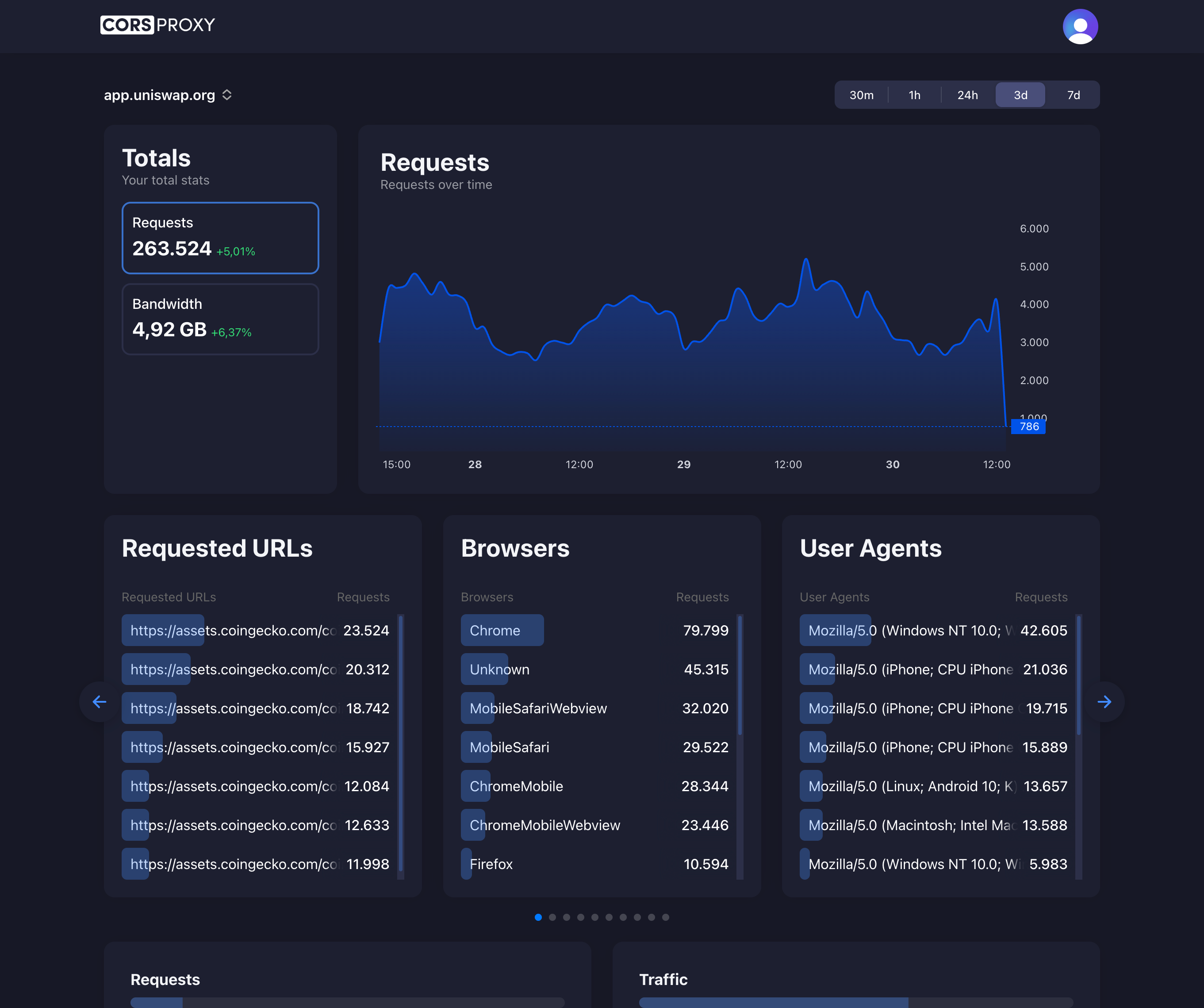
CoinGecko is one of the most popular cryptocurrency data aggregation platforms, providing comprehensive market data through its free and paid API tiers. However, developers frequently encounter rate limiting issues that can disrupt their applications. In this comprehensive guide, you’ll learn how to effectively bypass CoinGecko rate limits using smart proxy solutions and caching strategies.
Table of Contents
- Understanding CoinGecko Rate Limits
- Why Rate Limits Are a Problem
- CoinGecko API Rate Limit Tiers
- Common Rate Limit Errors
- Solution: Using CorsProxy with Dynamic Caching
- Implementation Examples
- Best Practices and Optimization Tips
- Troubleshooting
Understanding CoinGecko Rate Limits
CoinGecko implements rate limiting to protect its infrastructure from excessive requests and ensure fair usage across all users. Rate limits are enforced based on your IP address or API key, depending on whether you’re using the free or paid tier.
Key Points:
- Free API: 10-50 calls per minute (varies by endpoint)
- Demo API: 30 calls per minute across all endpoints
- Analyst/Pro API: Higher limits based on subscription tier
- Rate limits reset every minute
When you exceed these limits, CoinGecko returns a 429 Too Many Requests error, blocking your requests until the rate limit window resets.
Why Rate Limits Are a Problem
Rate limits can severely impact your application’s functionality, especially when:
- Building Real-Time Dashboards: Displaying live cryptocurrency prices requires frequent API calls
- Data Collection: Aggregating historical data or tracking multiple coins simultaneously
- High-Traffic Applications: Serving many users who need up-to-date market information
- Development and Testing: Rapid iteration during development can quickly exhaust rate limits
- Multi-User Scenarios: Different users accessing your app share the same rate limit pool
CoinGecko API Rate Limit Tiers
Understanding CoinGecko’s rate limit structure helps you plan your API usage strategy:
| Tier | Calls/Minute | Monthly Cost | Best For |
|---|---|---|---|
| Free | 10-50* | $0 | Personal projects, testing |
| Demo | 30 | $0 | Proof of concepts |
| Analyst | 500 | $129 | Small applications |
| Pro | 2,000+ | Custom | Enterprise applications |
*Varies by endpoint complexity
Common Rate Limit Errors
When you hit CoinGecko’s rate limits, you’ll encounter these typical error responses:
HTTP 429 Error:
{
  "error": "You've exceeded the Rate Limit. Please retry later or upgrade your plan."
}
Console Error:
Failed to fetch: 429 Too Many Requests
Response Headers:
X-RateLimit-Limit: 50
X-RateLimit-Remaining: 0
Retry-After: 60
These errors halt your application’s ability to fetch cryptocurrency data until the rate limit resets.
Solution: Using CorsProxy with Dynamic Caching
The most effective way to bypass CoinGecko rate limits is to use CorsProxy.io with its built-in dynamic caching feature. This approach provides multiple benefits:
Why This Solution Works
- Automatic Caching: Responses are cached at edge servers, reducing redundant API calls
- Rate Limit Protection: Cached responses don’t count toward your rate limit
- Improved Performance: Edge caching provides instant response times for cached data
- Regional Distribution: Cache is stored per data center for optimal global performance
- Customizable TTL: Control how long data is cached based on your needs
How Dynamic Caching Works
CorsProxy automatically caches all CoinGecko API responses with a default 1-hour TTL (time-to-live). Here’s how it works:
- First Request: CorsProxy fetches data from CoinGecko and caches the response
- Subsequent Requests: Cached data is served instantly without hitting CoinGecko’s API
- Cache Expiration: After the TTL expires, the next request fetches fresh data
- Automatic Refresh: Background updates keep your cache fresh (with API key + SWR)
Cache Benefits:
- Reduces CoinGecko API calls by up to 99%
- Serves responses in milliseconds instead of seconds
- Protects against rate limit errors
- No infrastructure management required
Implementation Examples
Basic Usage (JavaScript/TypeScript)
The simplest way to bypass CoinGecko rate limits with automatic caching:
// Without CorsProxy - prone to rate limits
const response = await fetch('https://api.coingecko.com/api/v3/simple/price?ids=bitcoin,ethereum&vs_currencies=usd');
const data = await response.json();

// With CorsProxy - automatic 1-hour caching
const proxyUrl = 'https://corsproxy.io/?url=';
const apiUrl = 'https://api.coingecko.com/api/v3/simple/price?ids=bitcoin,ethereum&vs_currencies=usd';

const response = await fetch(proxyUrl + encodeURIComponent(apiUrl));
const data = await response.json();
console.log(data); // Cached for 1 hour by default
React Example with Dynamic Updates
import { useState, useEffect } from 'react';

interface CryptoPrice {
  bitcoin: { usd: number };
  ethereum: { usd: number };
}

function CryptoDashboard() {
  const [prices, setPrices] = useState<CryptoPrice | null>(null);
  const [loading, setLoading] = useState(true);

  useEffect(() => {
    const fetchPrices = async () => {
      try {
        const proxyUrl = 'https://corsproxy.io/?url=';
        const apiUrl = 'https://api.coingecko.com/api/v3/simple/price?ids=bitcoin,ethereum&vs_currencies=usd';

        const response = await fetch(proxyUrl + encodeURIComponent(apiUrl));
        const data = await response.json();

        setPrices(data);
        setLoading(false);
      } catch (error) {
        console.error('Error fetching prices:', error);
        setLoading(false);
      }
    };

    fetchPrices();

    // Refresh every 5 minutes (cache serves most requests)
    const interval = setInterval(fetchPrices, 300000);

    return () => clearInterval(interval);
  }, []);

  if (loading) return <div>Loading prices...</div>;

  return (
    <div>
      <h2>Cryptocurrency Prices</h2>
      <div>Bitcoin: ${prices?.bitcoin.usd.toLocaleString()}</div>
      <div>Ethereum: ${prices?.ethereum.usd.toLocaleString()}</div>
    </div>
  );
}

export default CryptoDashboard;
Advanced: Custom Cache Duration
For even better control, use an API key to customize cache duration:
// Cache for 6 hours with stale-while-revalidate
const proxyUrl = 'https://corsproxy.io/';
const apiUrl = 'https://api.coingecko.com/api/v3/coins/markets?vs_currency=usd&order=market_cap_desc&per_page=100';

const params = new URLSearchParams({
  url: apiUrl,
  key: 'YOUR_API_KEY',
  ttl: '6h',        // Cache for 6 hours
  swr: '1h'         // Serve stale content for 1 hour while revalidating
});

const response = await fetch(`${proxyUrl}?${params}`);
const data = await response.json();
Cache Duration Options:
30m- 30 minutes (high-frequency updates)1h- 1 hour (default, good for most use cases)6h- 6 hours (daily price tracking)1d- 1 day (historical data)1w- 1 week (long-term analytics)
Node.js Backend Example
const express = require('express');
const app = express();

const PROXY_URL = 'https://corsproxy.io/?url=';

app.get('/api/crypto-prices', async (req, res) => {
  try {
    const coins = req.query.coins || 'bitcoin,ethereum,cardano';
    const apiUrl = `https://api.coingecko.com/api/v3/simple/price?ids=${coins}&vs_currencies=usd,eur&include_24hr_change=true`;

    const response = await fetch(PROXY_URL + encodeURIComponent(apiUrl));
    const data = await response.json();

    // Check cache status
    const cacheStatus = response.headers.get('X-Cache');
    console.log(`Cache status: ${cacheStatus}`); // HIT, MISS, or STALE

    res.json({
      prices: data,
      cached: cacheStatus === 'HIT',
      timestamp: new Date().toISOString()
    });
  } catch (error) {
    res.status(500).json({ error: 'Failed to fetch cryptocurrency prices' });
  }
});

app.listen(3000, () => {
  console.log('Crypto API server running on port 3000');
});
Python Example
import requests
from urllib.parse import quote

def fetch_coingecko_data(endpoint, params=None):
    """
    Fetch data from CoinGecko API using CorsProxy with caching
    """
    base_url = "https://api.coingecko.com/api/v3"
    proxy_url = "https://corsproxy.io/?url="

    # Build the full API URL
    api_url = f"{base_url}/{endpoint}"
    if params:
        param_string = "&".join([f"{k}={v}" for k, v in params.items()])
        api_url = f"{api_url}?{param_string}"

    # Make request through proxy
    full_url = proxy_url + quote(api_url)
    response = requests.get(full_url)

    # Check cache status
    cache_status = response.headers.get('X-Cache', 'UNKNOWN')
    print(f"Cache status: {cache_status}")

    return response.json()

# Example usage
prices = fetch_coingecko_data('simple/price', {
    'ids': 'bitcoin,ethereum',
    'vs_currencies': 'usd,eur',
    'include_24hr_change': 'true'
})

print(f"Bitcoin: ${prices['bitcoin']['usd']}")
print(f"Ethereum: ${prices['ethereum']['usd']}")
Best Practices and Optimization Tips
1. Choose Appropriate Cache Durations
Match your cache TTL to your data freshness requirements:
- Real-time trading apps: 30m - 1h (balance freshness vs. rate limits)
- Portfolio trackers: 1h - 6h (hourly updates sufficient)
- Analytics dashboards: 6h - 1d (daily snapshots work well)
- Historical data: 1d - 1w (static historical data)
2. Implement Stale-While-Revalidate (SWR)
Use the SWR pattern to serve instant responses while updating in the background:
// Serve cached data instantly, update in background
const params = new URLSearchParams({
  url: apiUrl,
  key: 'YOUR_API_KEY',
  ttl: '1h',
  swr: '30m'  // Serve stale data for 30 minutes while fetching fresh data
});
3. Batch API Requests
Minimize API calls by requesting multiple coins in a single request:
// Good: Single request for multiple coins
const apiUrl = 'https://api.coingecko.com/api/v3/simple/price?ids=bitcoin,ethereum,cardano,polkadot&vs_currencies=usd';

// Bad: Multiple requests for individual coins
// const btc = await fetch('...price?ids=bitcoin...');
// const eth = await fetch('...price?ids=ethereum...');
4. Monitor Cache Performance
Check cache headers to optimize your implementation:
const response = await fetch(proxyUrl + encodeURIComponent(apiUrl));

// Cache status: HIT (served from cache), MISS (fresh fetch), STALE (SWR)
const cacheStatus = response.headers.get('X-Cache');

// Time remaining in cache (seconds)
const cacheTtl = response.headers.get('X-Cache-TTL');

// Age of cached response (seconds)
const age = response.headers.get('Age');

console.log(`Cache: ${cacheStatus}, TTL: ${cacheTtl}s, Age: ${age}s`);
5. Handle Errors Gracefully
async function fetchCryptoData(coins) {
  const proxyUrl = 'https://corsproxy.io/?url=';
  const apiUrl = `https://api.coingecko.com/api/v3/simple/price?ids=${coins}&vs_currencies=usd`;

  try {
    const response = await fetch(proxyUrl + encodeURIComponent(apiUrl));

    if (!response.ok) {
      throw new Error(`HTTP error! status: ${response.status}`);
    }

    return await response.json();
  } catch (error) {
    console.error('Error fetching crypto data:', error);
    // Return cached data or fallback values
    return getCachedData(coins);
  }
}
6. Use Local Storage for Additional Caching
Combine proxy caching with browser local storage for offline support:
async function getCryptoPrices(coins) {
  const cacheKey = `crypto_${coins}`;
  const cached = localStorage.getItem(cacheKey);

  if (cached) {
    const { data, timestamp } = JSON.parse(cached);
    const age = Date.now() - timestamp;

    // Use cached data if less than 5 minutes old
    if (age < 300000) {
      return data;
    }
  }

  // Fetch through proxy (already cached at edge)
  const proxyUrl = 'https://corsproxy.io/?url=';
  const apiUrl = `https://api.coingecko.com/api/v3/simple/price?ids=${coins}&vs_currencies=usd`;

  const response = await fetch(proxyUrl + encodeURIComponent(apiUrl));
  const data = await response.json();

  // Cache locally
  localStorage.setItem(cacheKey, JSON.stringify({
    data,
    timestamp: Date.now()
  }));

  return data;
}
Troubleshooting
Issue: Still Getting Rate Limited
Solution: Ensure you’re properly encoding the URL and the cache is working:
// Correct: URL is properly encoded
const url = proxyUrl + encodeURIComponent(apiUrl);

// Check if cache is working
const response = await fetch(url);
const cacheStatus = response.headers.get('X-Cache');
console.log('Cache status:', cacheStatus); // Should be HIT after first request
Issue: Stale Data
Solution: Reduce TTL or implement SWR for background updates:
// Reduce cache duration for more frequent updates
const params = new URLSearchParams({
  url: apiUrl,
  key: 'YOUR_API_KEY',
  ttl: '15m',  // Cache for 15 minutes only
  swr: '5m'    // Revalidate every 5 minutes
});
Issue: CORS Errors
Solution: CorsProxy automatically handles CORS. If you still get errors, check your URL encoding:
// Make sure URL is properly encoded
const encodedUrl = encodeURIComponent(apiUrl);
console.log('Encoded URL:', encodedUrl);

const response = await fetch(`https://corsproxy.io/?url=${encodedUrl}`);
Issue: Large Response Size
Solution: For responses over 1 MB, use an API key:
// Large responses require API key
const params = new URLSearchParams({
  url: apiUrl,
  key: 'YOUR_API_KEY',  // Required for files > 1 MB
  ttl: '1h'
});

const response = await fetch(`https://corsproxy.io/?${params}`);
Conclusion
Bypassing CoinGecko rate limits doesn’t require expensive API subscriptions or complex infrastructure. By using CorsProxy.io with its built-in dynamic caching feature, you can:
- Eliminate rate limit errors with automatic edge caching
- Improve performance with instant cached responses
- Reduce costs by minimizing direct API calls
- Scale effortlessly without infrastructure management
The default 1-hour cache works perfectly for most cryptocurrency applications, and you can customize cache duration with an API key for more specific needs. Start using CorsProxy today to build reliable, high-performance cryptocurrency applications without rate limit headaches.
Ready to bypass CoinGecko rate limits? Visit corsproxy.io and start making unlimited cached requests to CoinGecko’s API with just one line of code.